



Ardennes Counteroffensive - Battle of the Bulge Front Line Progression Map
Ardennes Counteroffensive - Battle of the Bulge Front Line Progression Map
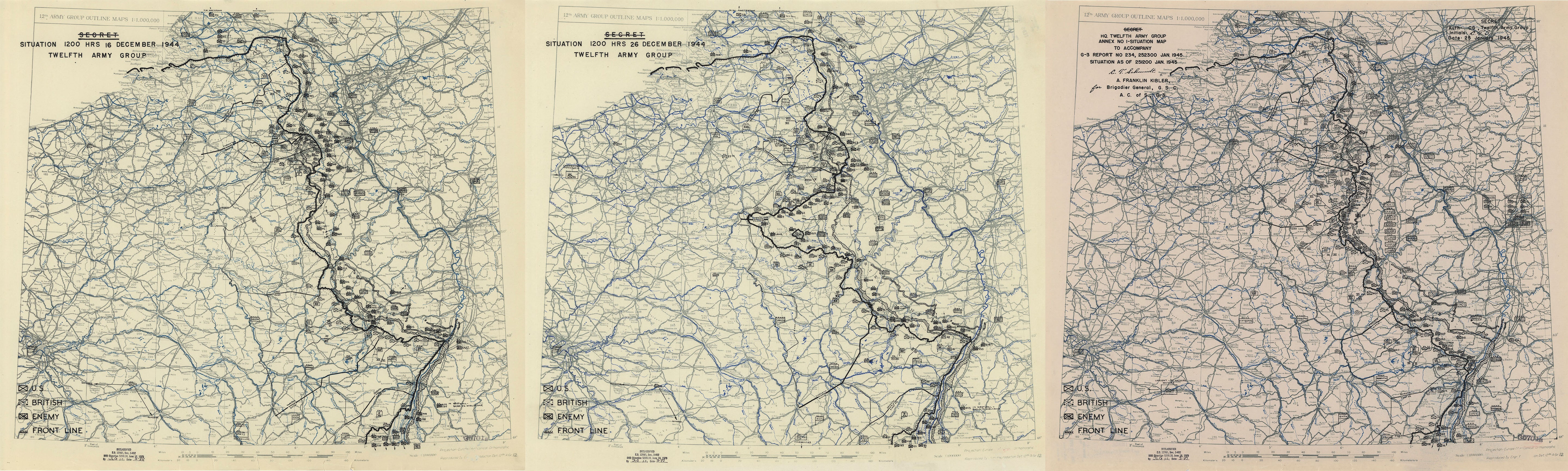
The American divisions that held, lost and retook the Ardennes are drawn unit by unit on these three Secret situation maps from Headquarters Twelfth Army Group, showing the front at noon on December 16, 1944, December 26, 1944 and January 25, 1945, and offered here side by side as one museum-quality reproduction. Together they cover the Battle of the Bulge from its first day to its last. Each map carries the number of every division on the line. A family can find a soldier's division on all three dates and see where it stood.
Historical Context
The Battle of the Bulge was fought from December 16, 1944 to January 25, 1945 in the Ardennes region of Belgium and Luxembourg. Before dawn on December 16 three German armies attacked a thinly held sector of the U.S. First Army. Over the next ten days they drove a salient some fifty miles deep into the American line, reaching toward the Meuse River and surrounding the road center of Bastogne. The advance stopped short of the Meuse in the last days of December. American counterattacks from the north and south then closed the salient, and by late January the front stood close to where it had been.
The Map's Features
All three maps are printed on the "12th Army Group Outline Maps 1:1,000,000" base, with a legend for U.S., British and enemy units and the front line. The December 16 map shows an unbroken front, with the 99th, 106th, 28th and 4th Infantry Divisions spread along it and question marks beside several German units to the east. The December 26 map shows the line pushed west to within a few miles of Dinant on the Meuse, with the 101st Airborne Division drawn inside a closed ring at Bastogne and the 4th Armored, 26th and 80th Divisions of III Corps just to the south. The January 25 map shows the front back near the German border. Its title block reads "Annex No 1 – Situation Map to accompany G-3 Report No 234" and is signed for Brigadier General A. Franklin Kibler, the army group's G-3. The Secret marking on each map is struck through.
Historical Significance
These maps were drawn at the headquarters that commanded most of the American armies on the Western Front, and they record what that headquarters knew at noon on each day. At noon on December 16, hours after the attack began, its map still showed a quiet front. At noon on December 26 it showed Bastogne cut off; the 4th Armored Division reached the town later that afternoon. The January 25 map marks the date the U.S. Army gives as the end of the campaign.
Museum-Quality Reproduction
This is a high-quality reproduction of the original historic map, professionally printed on premium archival paper using the Giclée printing process to preserve fine cartographic detail, line clarity, and period authenticity for long-term display.
Perfect For
- Families of veterans who fought in the Ardennes
- World War II collectors and military historians
- Veterans and serving military professionals
- Teachers and serious students of the campaign in Western Europe
- Home offices, libraries and studies
Specifications
- Depicts: U.S., British and German positions at 1200 hours on December 16, 1944, December 26, 1944 and January 25, 1945; Battle of the Bulge fought December 16, 1944 – January 25, 1945
- Conflict: World War II, European Theater
- Original Publication: December 1944 and January 1945
- Publisher: Headquarters Twelfth Army Group, G-3 Section; reproduced by the Engineer Reproduction Detachment, 12th Army Group
- Style: Three U.S. Army Secret situation maps printed side by side
- Original Scale: 1:1,000,000
- Product Type: Giclée reproduction on premium archival paper
- Printed In: Rochester Hills, Michigan
Dimensions (Width x Height): 40 x 12 inches (101.6 x 30.5 cm)
Each map is printed using the finest materials and methods. Your map will be handled with white gloves from start to finish. We use the Giclée printing method on premium archival paper, which produces a clear, extremely detailed, durable map perfect for proud display in your home or office.
Read more in Field Notes: The Battle of the Bulge: Germany's Last Offensive in the West
Choose options
